+86-13416307598 | +86 020 2262 6603 | inquiry@pearltransformer.com

English 
Views: 0 Author: Site Editor Publish Time: 2025-01-21 Origin: Site
Power transformers are essential components in electrical power systems, and every power transformer generates heat during operation. To ensure efficient and safe operation, a range of cooling methods is used to dissipate this heat. The choice of cooling method depends on factors such as the power transformer’s size, rating, and specific application. Below is a detailed explanation of the common cooling methods applied to a power transformer, how they work, and their advantages and limitations.
Process: The power transformer’s heat is dissipated through natural convection of air. The outer surface and any attached radiators are exposed to the surrounding air; heat from the core and windings is transferred to the tank and radiators, which release it to the air.
Advantages: Simple, cost-effective, and reliable.
Limitations: Limited cooling capacity, susceptible to ambient temperature variations.
Process: Fans force cool air over the power transformer’s surface, increasing the rate of heat transfer and enhancing cooling capacity over natural air cooling.
Advantages: Improved cooling capacity; can handle higher loads.
Limitations: Requires additional equipment (fans), increased noise levels.
Process: The power transformer is immersed in oil, acting as both an insulating and cooling medium. Heat is transferred to the oil, which circulates naturally in the tank and releases heat through the tank walls.
Advantages: Good insulation, high dielectric strength, effective heat dissipation.
Limitations: Requires regular oil maintenance, potential for oil leaks.
Process: Combines oil immersion with forced air. Fans force air over the tank, increasing heat transfer from oil to air.
Advantages: Improved cooling capacity over ONAN, handles higher loads.
Limitations: Requires additional fans, increased noise.
Process: Oil is pumped through the power transformer and an external oil cooler; fans cool the oil, which is then circulated back.
Advantages: High cooling capacity, suitable for large power transformers.
Limitations: Requires complex equipment (pumps, oil coolers, fans).
Process: Similar to OFAF, but water is used instead of air to cool the oil in the external cooler.
Advantages: Very high cooling capacity, suitable for extremely large power transformers.
Limitations: Requires a water source, risk of water contamination.
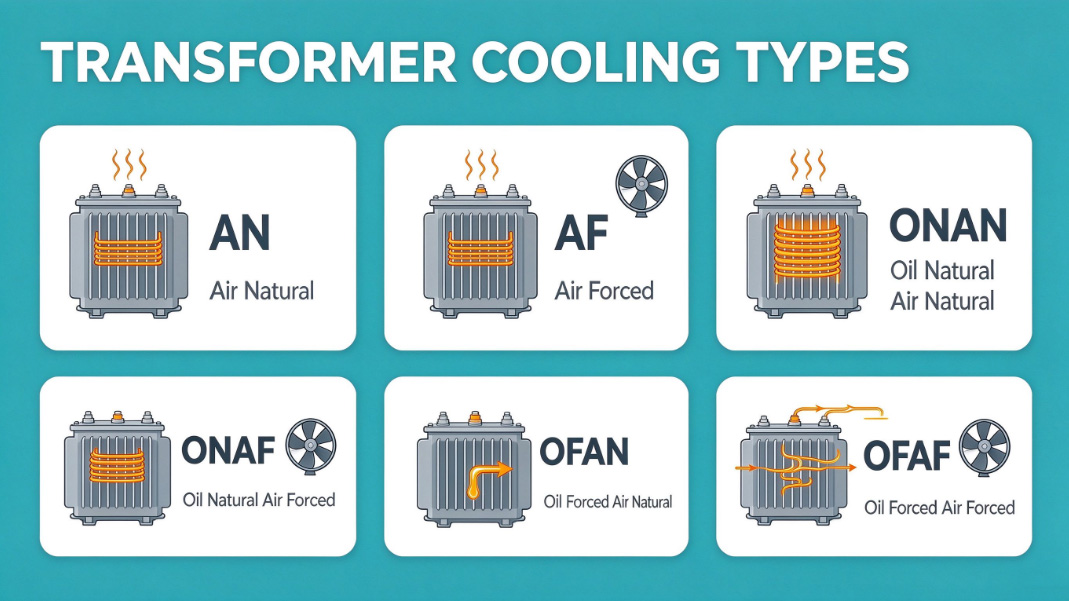
Power transformer size and rating: larger units generally require more sophisticated cooling.
Ambient temperature: high ambient temperatures may demand more effective cooling.
Load conditions: frequent overloading may require a cooling method with higher overload capacity.
Installation location: indoor or outdoor installation influences the choice of cooling method.
Dry-type power transformers: use no oil; they may employ air blast cooling or vacuum pressure impregnation.
Special cooling methods: for specific applications, direct water cooling or helium cooling may be used.
Loadability: the maximum load a power transformer can carry under specified conditions.
Heat dissipation: the process of removing heat from the power transformer.
Insulating medium: a material used to prevent electrical breakdown inside the power transformer.
Selecting the right cooling method is essential to the long-life, safe, and efficient operation of any power transformer. Pearl Electric, a professional power transformer manufacturer since 1958, designs and supplies both dry-type and oil-immersed power transformers with AN, AF, ONAN, ONAF, OFAF, and OFWF cooling options to match your site, load, and ambient conditions. Contact our engineering team to specify the cooling method that best fits your power transformer application.


