+86-13416307598 | +86 020 2262 6603 | inquiry@pearltransformer.com

English 
Views: 0 Author: Site Editor Publish Time: 2024-12-31 Origin: Site
Many magnetic‑conductive substances exist, including titanium‑based alloys, copper‑based alloys, and iron strontium titanate. Although these materials offer decent magnetic conductivity, silicon steel sheet remains the dominant transformer core material for power‑frequency transformer equipment.
Silicon steel offers comprehensive advantages that make it ideal as a transformer core material:
High magnetic permeability: It provides smooth closed magnetic flux paths for transformer windings.
Low core loss: Compared with alternative magnetic materials, silicon steel generates far lower iron loss during alternating‑magnetic‑field operation. Its superior hysteresis performance enables fast magnetic‑domain response, greatly cutting hysteresis loss.
Good corrosion resistance: It maintains stable performance under various chemical ambient conditions.
Cost‑effective: While silicon steel sheet carries a moderate purchase price, its long service life brings outstanding overall cost‑performance.
Sufficient mechanical strength: It offers reliable mechanical support for transformer windings and other internal assemblies.
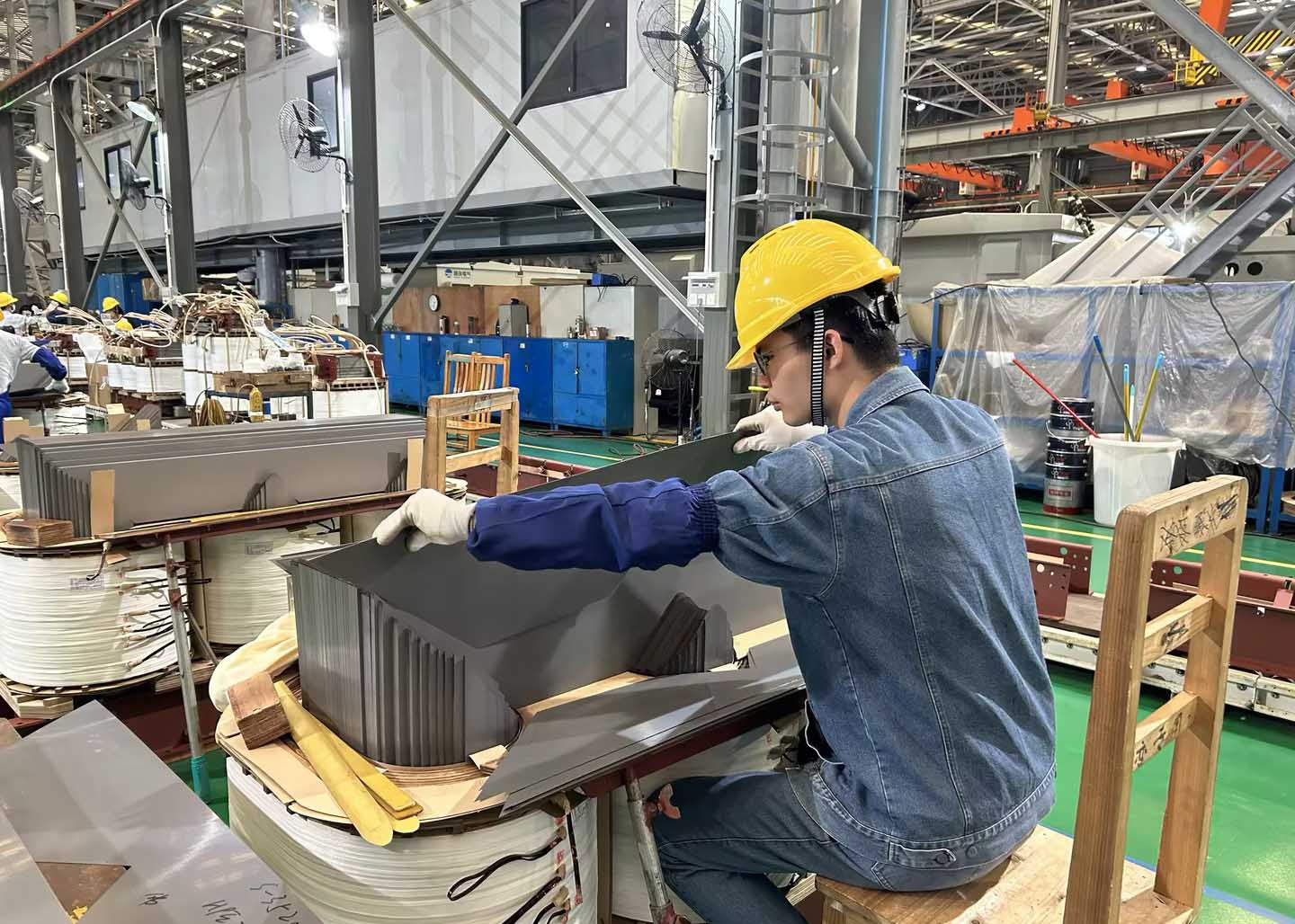
Solid thick silicon steel blocks produce severe eddy‑current loss under alternating magnetic flux. When silicon steel is made into thin insulated sheets for the transformer core material, eddy‑current loss can be significantly reduced.
A transformer iron core is assembled by stacking mutually‑insulated silicon steel sheets. Each thin lamination limits the cross‑section available for eddy‑current circulation, raising electric resistance along eddy‑current paths and suppressing energy waste from eddy currents.
Laminated processing also brings manufacturing flexibility. Manufacturers can select qualified raw silicon steel sheets, perform precise cutting according to design requirements, and strictly control thickness and flatness. This process saves raw‑material consumption, lowers production cost, and improves transformer reliability.
|
|
Cold‑rolled silicon steel sheet: Rolled under room‑temperature conditions. It features a smooth surface, no cracks, uniform density, and stable magnetic properties. It can be further divided into ordinary type and high‑silicon type by silicon content.
Hot‑rolled silicon steel sheet: Produced via high‑temperature rolling. It costs less than cold‑rolled grades, yet has an inferior surface finish and slightly poorer magnetic performance. It includes ordinary, high‑silicon, and ultra‑high‑silicon variants.
Cold‑rolled non‑oriented silicon steel sheet: One widely‑adopted grade for transformer core material. It delivers high permeability and low magnetic loss, suitable for small‑size power transformers and inductors.
Cold‑rolled oriented silicon steel sheet: Grains are direction‑aligned in production. Its magnetization direction matches core magnetic‑flux paths to reduce iron loss and magnetic loss. It is widely used for high‑power transformers and electric motors.
Hot‑rolled oriented silicon steel sheet: A premium grade for high‑end power‑industry equipment such as large‑capacity transformers and frequency converters, delivering excellent magnetic performance and higher core efficiency.
Silicon steel sheets are available in EI‑type, UI‑type, C‑type, square‑frame, and other shapes. Square‑frame silicon steel sheets are commonly adopted for high‑power transformers thanks to reliable insulation, favorable heat dissipation, and a short magnetic circuit.
Forged (black sheet): High‑temperature treated to form a surface oxide film for enhanced insulation performance.
Non‑forged (white sheet): Retains original smooth surface without oxide‑film forging treatment.
Silicon steel sheet remains the most widely‑used transformer core material. Alternative core materials are available yet limited by complicated production workflows and higher cost. For instance, special cores for dry‑type transformers adopt modified material solutions for specific working scenarios.


