+86-13416307598 | +86 020 2262 6603 | inquiry@pearltransformer.com

English 
Views: 0 Author: Site Editor Publish Time: 2025-01-21 Origin: Site
An amorphous alloy transformer is an energy‑efficient electrical transformer that uses amorphous metal alloy as its core material, instead of the conventional crystalline silicon steel found in traditional transformers.
The word "amorphous" means "without a regular form". In an amorphous metal alloy, the atoms are arranged randomly rather than in the ordered, repeating crystal lattice typical of silicon steel. This unique atomic structure gives the material distinctive magnetic properties, which is exactly why the amorphous alloy transformer delivers lower core loss, higher efficiency, and longer service life than equivalent silicon‑steel units.
Because of these benefits, the amorphous alloy transformer has become one of the fastest‑growing product categories in global distribution networks, particularly in projects where energy conservation and low operating cost are top priorities.
To understand why the amorphous alloy transformer outperforms conventional designs, it is necessary to look closely at its core material.
Amorphous metal alloy, often referred to as "metallic glass", is a special metal produced by rapid cooling of molten alloy at extremely high speeds (typically above one million degrees Celsius per second). This ultra‑fast cooling prevents the atoms from arranging into a regular crystalline structure, so the finished material keeps a disordered, glass‑like atomic layout.
Because of this random atomic arrangement, amorphous metal alloy exhibits magnetic properties that are superior to crystalline silicon steel for transformer core applications. The absence of grain boundaries – which are weak points in crystalline materials – also improves the alloy's mechanical strength and corrosion resistance.
The transformer core is the heart of the machine. It provides a closed magnetic circuit through which the alternating magnetic flux can pass between the primary and secondary windings. The performance of this core directly governs core loss, no‑load current, noise level, and overall operating efficiency.
In a traditional silicon‑steel transformer, the crystalline grain structure forces the magnetic domains to overcome grain boundaries when the field alternates, which produces hysteresis loss. In an amorphous alloy transformer, the disordered atomic arrangement allows magnetic domains to respond more easily, resulting in a very narrow hysteresis loop and dramatically lower hysteresis losses.
The working principle of an amorphous alloy transformer is identical to that of a conventional transformer.
When an alternating current flows through the primary winding, it creates a continuously changing magnetic field inside the amorphous alloy core. This changing magnetic field then induces an electromotive force in the secondary winding, allowing voltage and current to be transformed to the required levels while transferring power from the input to the output side.
The key difference lies in the core. Because the amorphous metal core can be magnetized and demagnetized with less energy, the amorphous alloy transformer wastes less electrical energy as heat during every cycle of the alternating current. Over thousands of hours of operation, this small difference per cycle accumulates into substantial energy savings.
The amorphous alloy transformer brings a wide range of technical and economic benefits compared with silicon‑steel designs.
The most celebrated advantage of the amorphous alloy transformer is its extremely low no‑load loss. Core loss is the energy dissipated inside the transformer core, even when no load is connected, caused by hysteresis and eddy currents. Thanks to the random atomic structure of the amorphous alloy, the no‑load loss of an amorphous alloy transformer can be reduced by roughly 60% to 80% compared with an equivalent traditional silicon‑steel transformer. For a utility running hundreds of units around the clock, this translates into enormous energy and cost savings over the transformer's lifetime.
Amorphous alloys possess high magnetic permeability, meaning they can be magnetized and demagnetized very easily. This leads to lower excitation current and further reduces no‑load losses. A more responsive core also improves the overall efficiency of the amorphous alloy transformer under both full‑load and partial‑load conditions.
Because the amorphous structure produces a narrow hysteresis loop, the energy lost in repeatedly reversing the magnetization direction is much smaller. Combined with low eddy‑current losses, the total core loss of the amorphous alloy transformer stays well below that of conventional transformers.
With a more efficient core, the amorphous alloy transformer maintains more stable output voltage across varying load conditions. Good voltage regulation protects sensitive downstream equipment and improves power quality for end users.
Amorphous alloy cores tend to operate with lower noise and vibration levels than silicon‑steel cores, making the amorphous alloy transformer well suited for residential areas, commercial buildings, and other noise‑sensitive installations.
Reduced thermal stress from lower core losses, combined with corrosion‑resistant core material, contributes to a longer operational life for the amorphous alloy transformer. This lowers the total cost of ownership and reduces the frequency of replacement.
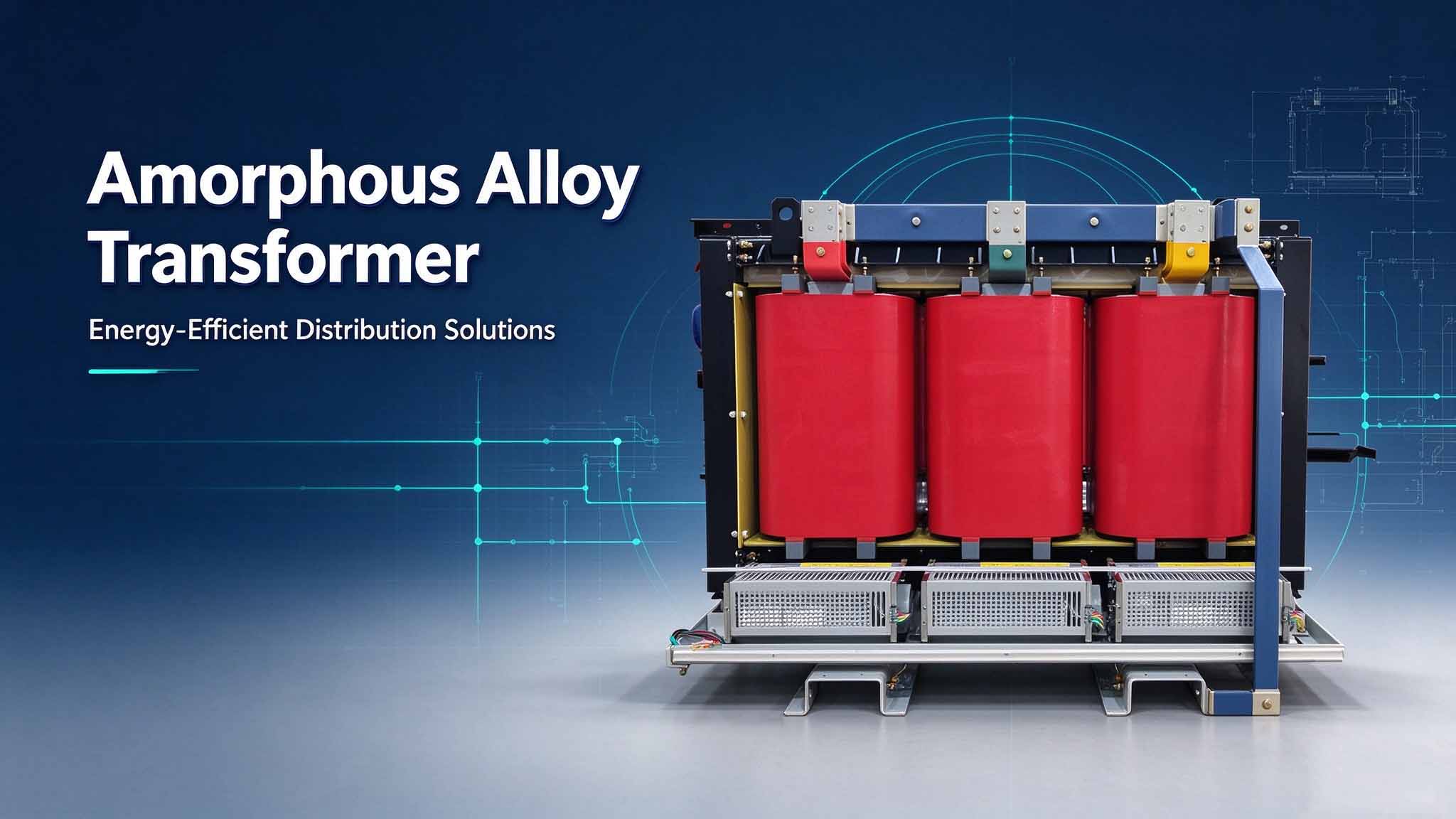
The amorphous alloy transformer is deployed across a broad range of power‑distribution and industrial scenarios.
The most common application of the amorphous alloy transformer is in distribution networks, supplying power to residential communities, commercial buildings, and small industrial users. High efficiency and low noise make it an excellent choice where transformers operate for long periods at low average loading – exactly the condition where core‑loss savings matter most.
In power generation and transmission systems, the amorphous alloy transformer is employed to reduce transmission losses. Although the initial investment may be higher than for silicon‑steel units, the rapid payback through energy savings makes it attractive for utilities and large‑scale industrial operators.
Solar farms, wind power plants, and energy‑storage stations increasingly specify the amorphous alloy transformer because these systems run through long daylight or high‑output cycles where efficiency directly affects profitability. Low losses and stable performance make it a preferred choice for modern renewable‑energy projects.
For applications that demand exceptionally low losses – such as data centers, hospitals, and precision manufacturing – the amorphous alloy transformer offers a dependable, high‑performance solution.
Beyond economic advantages, the amorphous alloy transformer supports sustainable development in several measurable ways.
Because the amorphous alloy transformer cuts no‑load losses dramatically, it lowers electricity consumption across the grid. Lower consumption means reduced demand on power plants and, in turn, lower greenhouse‑gas emissions. For countries advancing carbon‑neutrality targets, widespread adoption of amorphous alloy transformers is a practical, high‑impact measure.
The longer service life of the amorphous alloy transformer reduces the frequency of replacement and the volume of discarded equipment, minimizing electronic waste and conserving raw materials.
With higher efficiency per unit of capacity, an amorphous alloy transformer can often achieve the required performance with less core material, contributing to resource efficiency across the manufacturing chain.
When sourcing an amorphous alloy transformer, buyers should evaluate several key parameters to ensure they receive a reliable, cost‑effective product.
No‑load loss (W): Compare the specified no‑load loss with equivalent silicon‑steel units; a quality amorphous alloy transformer should show a substantial reduction.
Rated capacity (kVA/MVA): Confirm the transformer matches the actual load profile, including expected peak and average loading.
Voltage rating and tap range: Ensure the primary and secondary voltages and tap‑changer range fit the local grid.
Cooling method (ONAN / KNAN / AN / AF): Choose the cooling configuration appropriate to the installation environment and fire‑safety requirements.
Noise level (dB): For residential or indoor sites, verify the acoustic performance.
Certifications and standards: Check compliance with international standards such as IEC 60076, GB 1094, and relevant energy‑efficiency classifications.
Manufacturer experience: Source from a manufacturer with a proven track record, full testing facilities, and reliable after‑sales support, such as Pearl Electric.
Understanding the material itself helps engineers appreciate why the amorphous alloy transformer performs so well.
Amorphous alloys exhibit exceptionally high strength and hardness, often exceeding crystalline alloys. This is attributed to the absence of grain boundaries, which removes weak points where cracks tend to nucleate and propagate.
The dense, uniform structure and lack of grain boundaries give amorphous alloys superior resistance to corrosion and oxidation, contributing to the durability of the amorphous alloy transformer core.
Many amorphous alloys exhibit soft magnetic behavior – they can be easily magnetized and demagnetized. This makes them ideal for transformer cores and magnetic sensors, where low losses and quick response are required.
Amorphous alloys can deform significantly without fracturing and display excellent wear resistance, making them useful in cutting tools and protective coatings.
Amorphous alloys generally have higher electrical resistivity than crystalline alloys, which helps limit eddy‑current losses within the core – another reason the amorphous alloy transformer achieves such low total losses.
Some amorphous alloys are biocompatible, enabling their use in biomedical implants. While not directly relevant to transformer manufacturing, this demonstrates the versatility of the material family.
In conclusion, the amorphous alloy transformer represents a significant technological advance over traditional silicon‑steel transformers in terms of energy efficiency, operational performance, and environmental impact. Its low no‑load loss, high permeability, low hysteresis loss, quiet operation, and long service life make it a preferred choice across distribution, power and renewable‑energy applications.
As a leading power‑transformer manufacturer, Pearl Electric combines advanced amorphous‑alloy core technology with rigorous quality control, international certifications and dedicated engineering support to deliver reliable, energy‑saving solutions for global customers. If you are planning a distribution network upgrade or a new renewable‑energy project, contact Pearl Electric to discuss how an amorphous-alloy transformer can reduce your operating costs and support your sustainability goals.


