+86-18826241798 | +86 020 2262 6603 | inquiry@pearltransformer.com

English 
Views: 0 Author: Site Editor Publish Time: 2026-08-10 Origin: Site
With the rapid expansion of wind power, photovoltaic power, and energy storage substations, oil-immersed transformers, which serve as the core equipment for grid voltage boosting and energy transmission, face severe challenges under the unique operating conditions of new energy systems. Accelerated aging of insulating oil has become a common industry problem. Frequent load fluctuations, harmonic disturbances, and bidirectional power impacts cause increases in transformer oil acidity, excessive dissolved gases, and premature sludge precipitation, directly increasing operation and maintenance costs and significantly shortening equipment service life. Traditional methods such as oil filtration, oil replacement, and adsorption purification can only passively remove aging products and cannot fundamentally prevent insulating oil degradation.
To address this industry challenge, we rely on our core patented technology — “Transformer Oil Circulation Plasma Enhancement Method and System” — to overcome the limitations of traditional post-event maintenance. By introducing a low-temperature plasma (NTP)-based electrochemical reaction mechanism, the system enables charged operation of insulating oil and molecular-level online restoration, creating an entirely new technological paradigm for online molecular repair of transformer insulating oil, fundamentally different from conventional oil filtration equipment.
The aging rate of insulating oil in new energy wind power and energy storage transformers is significantly higher than that of conventional equipment, mainly due to the combined acceleration effects of four special operating conditions.
Frequent fluctuations in renewable energy loads cause repeated changes in oil temperature. Following the insulation aging “6°C rule,” continuous temperature variations promote the generation of peroxides. Combined with hydrolysis and acidification of insulating paper, as well as oxygen ingress and moisture absorption caused by sealing degradation and leakage of the transformer tank, the aging process of insulating oil is significantly accelerated.
High-frequency harmonics and pulse voltages generated by grid-connected converters cause electric field distortion, inducing oil molecule ionization and generating oxidative free radicals. Meanwhile, harmonic losses create local hot spots, and together with catalytic effects from metal particles, further accelerate oil degradation.
Bidirectional charging and discharging operations of energy storage systems cause continuous micro-vibration of transformer windings, generating metal debris and damaging the oil-paper insulation interface. This induces partial discharge, producing fault gases and carbon particles through oil decomposition, continuously deteriorating oil quality.
Mechanical fixed-speed oil pumps release metal impurities due to wear during operation. Their thermal response is slow, and they can only provide heat dissipation without eliminating dissolved gases or neutralizing aging free radicals. The combined effects of multiple adverse factors create a closed loop of accelerated oil aging. Traditional maintenance methods address only symptoms rather than root causes and cannot adapt to complex and extreme new energy operating conditions.
Offline vacuum oil filtration can only remove free water, gases, and solid particles. It cannot effectively treat dissolved acidic substances and colloidal sludge, nor can it significantly reduce oil acidity and dielectric loss.
Adsorption regeneration relies on adsorbents to purify oil. However, adsorbents become saturated quickly and require frequent replacement. In addition, power outages are required for maintenance operations, resulting in a repeated cycle of purification followed by renewed aging.
Complete transformer oil replacement is extremely costly. For large main transformers in offshore booster stations, the total cost of a single oil replacement can reach the million-yuan level. It also generates significant hazardous waste, conflicting with green and low-carbon development objectives.
The industry urgently requires an integrated solution capable of continuous online operation while simultaneously enhancing heat dissipation and suppressing oil aging.
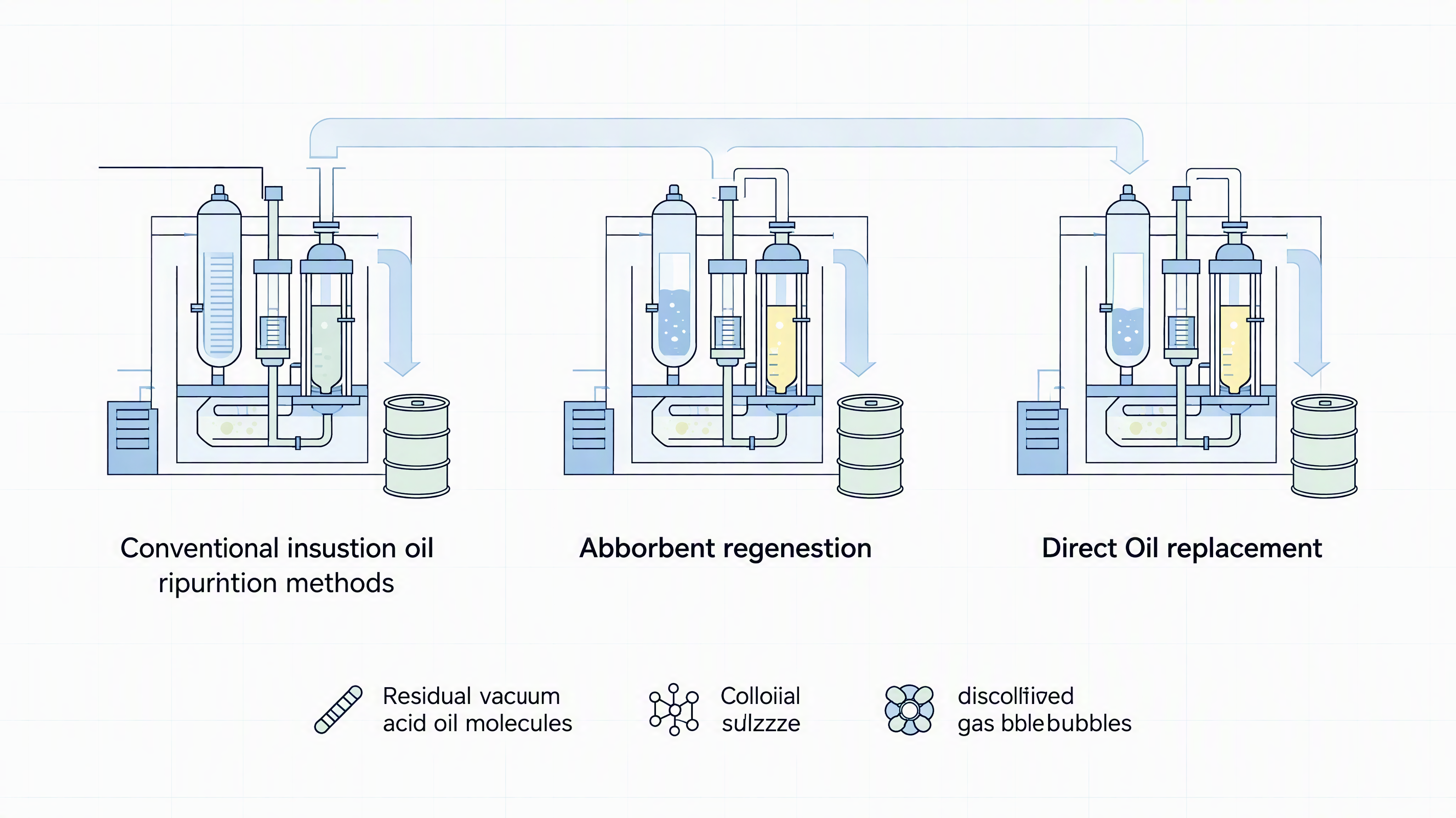
Problems with Existing Insulating Oil Purification Technologies
Based on the patented invention “Transformer Oil Circulation Plasma Enhancement Method and System,” Pearl Electric has achieved a key technological breakthrough in new energy transformer oil maintenance.
The independently developed patented technology adopts a dielectric barrier discharge (DBD) low-temperature plasma architecture. A sealed plasma generation unit is installed inside the oil tank and combined with an intelligent control system. The operating power can be adaptively adjusted according to oil temperature, load conditions, and oil quality. The system integrates mechanical-free oil circulation and online insulation purification, solving the fundamental problem of oil aging at its source.

Transformer Oil Circulation Plasma Enhancement Method and System
The system addresses temperature fluctuations, electric field disturbances, and accelerated oil oxidation caused by load variations in wind power and energy storage transformers through adaptive closed-loop regulation:
Using ion wind-driven mechanical-free oil circulation to rapidly dissipate hot spots and reduce thermal aging factors;
Continuously circulating insulating oil through the plasma reaction zone to efficiently decompose fault gases and quench oxidative free radicals;
Suppressing the formation of organic acids and sludge at the source, preventing metal corrosion and damage to insulation structures;
Equipped with real-time operating condition monitoring sensors, dynamically adjusting discharge intensity, and automatically reducing power consumption under low-load conditions.
The entire system forms a bidirectional synergistic closed loop: enhanced heat dissipation reduces thermal stress, while online purification interrupts aging chain reactions, precisely solving the key challenge of rapid insulating oil aging in new energy applications.
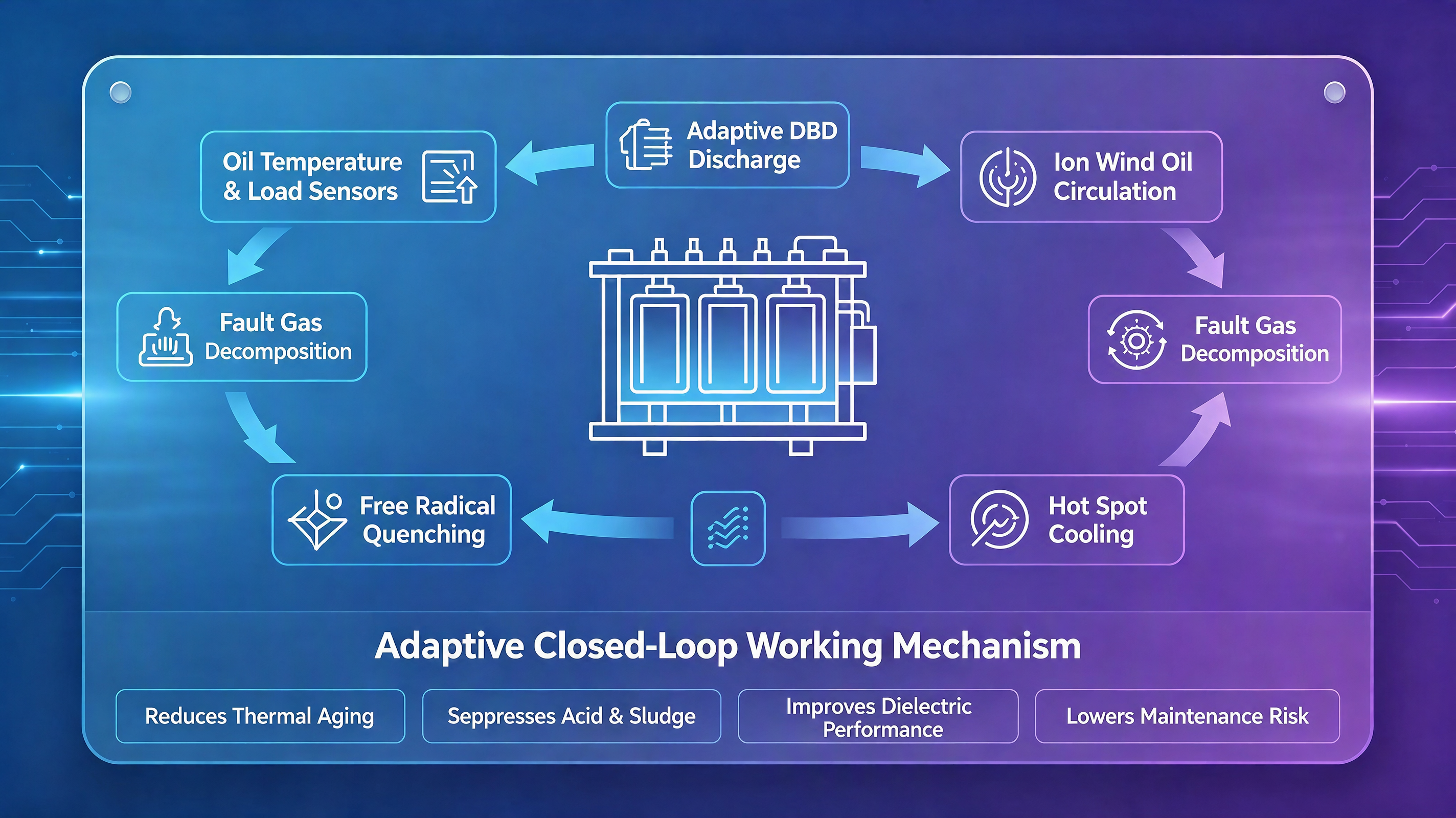
Transformer Adaptive Closed-Loop Working Mechanism
Technical Dimension | Traditional Mechanical Oil Pump + External Filtration | Plasma Oil Circulation Enhancement Integrated System |
Driving Method | Mechanical impeller with wear, continuously generating metal contaminants | Plasma ion wind with no moving parts and zero debris contamination |
Functional Scope | Heat dissipation only; purification relies on external equipment | Integrated heat dissipation and online oil purification |
Aging Suppression Mode | Passive filtration of existing contaminants; unable to stop oxidation reactions | Active quenching of free radicals and suppression of oil aging at the source |
Maintenance Mode | Regular filter replacement, oil pump inspection, and offline oil filtration required | Long-term online operation with minimal consumables and continuous operation capability |
Adaptability to Wind/Solar/Energy Storage Conditions | Slow response to load fluctuations and insufficient hot-spot control | Adaptive circulation adjustment suitable for frequent power fluctuations |
Safety Risk | External pipelines increase leakage risks; pump failures may cause overheating | Integrated internal structure with dielectric barrier insulation and high safety |
Compared with conventional solutions, this patented technology features no moving components and no consumables, enabling continuous online operation without shutdown. It integrates both enhanced heat dissipation and oil purification functions, making it highly suitable for the complex and unattended operating conditions of wind power, photovoltaic, and energy storage systems. The technology can effectively extend the service life of insulating oil and transformers, significantly reduce equipment procurement, routine maintenance, and hazardous waste disposal costs, minimize the risk of operational failures and downtime, safeguard power generation and energy storage revenues, while reducing carbon emissions associated with waste oil and enabling green and low-carbon operation throughout the entire project lifecycle.
Following the large-scale grid integration of wind power and energy storage systems, accelerated aging of transformer insulation systems has become a critical bottleneck restricting power station asset lifetime and reducing investment returns. Traditional transformer operation and maintenance solutions are unable to meet the unique load characteristics of new energy applications. Leveraging our proprietary core patents, we have overcome the conventional technical separation between cooling and purification systems by integrating plasma fluid-driven technology with low-temperature plasma purification technology, directly addressing the fundamental challenge of insulating oil aging in new energy transformers.

Transformer Wide Application Scenarios & Green Benefits
This innovative technology represents a new direction in transformer thermal management and insulation maintenance. It can provide customized solutions for onshore and offshore wind power projects, centralized photovoltaic power plants, and large-scale electrochemical energy storage facilities, ensuring the safe, long-term, economical, and stable operation of high-voltage equipment in next-generation power systems.


